
Walk into many Boston offices and you will find a version of the same story. Papers pile up next to the printer. Cables tangle under the desk. Supplies get purchased twice because no one can find the first batch. Office clutter builds quietly. One busy week leaves a messy desk. Another busy week turns that desk into a permanent storage zone. Eventually, the workspace that should support your business starts working against it.
An organized office saves time, lowers stress, and makes it easier to focus. For busy professionals and growing teams across Greater Boston, office decluttering is one of the most practical projects you can take on. You do not need a major renovation or expensive furniture. You need a simple process, a little consistency, and sometimes an extra set of hands. The steps below help in any setting, whether that is a home office, a shared suite, or a corner desk at a startup.
Why an Organized Office Matters
Clutter costs more than floor space. When your desk is buried under loose papers, your attention splits in many directions. Searching for a file, a charger, or a pen eats minutes out of every day. Those minutes add up over a week, and the frustration makes it harder to focus on the work that matters.
A few clear signs that a workspace needs attention:
- You miss documents because they sit under newer paperwork.
- Office supplies are scattered across several rooms or drawers.
- The desk surface has not been completely clear in months.
- You book conference rooms because your own office is not presentable.
If these feel familiar, a short, focused organizing session can change the way the space works. Organizing Boston has helped clients in the Greater Boston area declutter and simplify their spaces for over 25 years, using a hands-on and judgment-free approach. The same method applies to business offices as it does to homes.
Plan Before You Touch the First Pile
Start with a plan instead of diving straight into a stack of paperwork. Choose a block of time when you have energy. Gather boxes or bags and label them keep, donate, recycle, and shred. Then work through one zone at a time: the desktop, the main drawer, the shelf, or the cabinet. Finish that zone before you move on. The visible progress from a clear desk or an empty drawer makes the rest of the project feel possible.
A timer helps too. A few focused twenty-minute sessions spread across a week produce real change in an average home office. Perfection is not the goal on day one. A useful system that you can maintain is.

Clear the Desk and Keep Daily Tools Close
Begin with the largest flat surface in the room. Move everything off the desk, wipe it down, and look at what you actually use on a normal workday. Most people need their computer, phone, a notebook, a pen, and a small tray for active files. Return those items and give everything else a proper home elsewhere. If something has not been touched in the past month, it should not live on the desk.
Make Fast Decisions About Paper
Paper is the biggest source of office clutter in most Boston businesses. Bills, client documents, meeting notes, and business cards pile up quickly. The solution is a fast decision the moment you touch each piece.
Ask whether a document has legal, financial, or client value. If it does, file it or scan it. Ask whether it belongs to a project that is active right now. If it does, place it in a labeled project file. If you could find the information online later, recycle or shred it. Handling each paper once and moving it to a final home keeps piles from reforming on the desk.
Give Supplies and Equipment a Permanent Home
Supplies disappear when they lack a dedicated spot. Assign one place to each category and label it clearly. Pens go in one container. Notebooks sit on one shelf. Shipping materials stay in one cabinet. When each item has a home, everyone knows where to return it after use.
This is also the right time to handle duplicates. If you own three staplers or a collection of half-used notebooks, keep one and move the rest to a shared closet, another team, or a donation box. Storage bins and drawer dividers help keep small items sorted, but buy them only after you declutter. Sort first, measure the space, then choose containers that fit what remains.
Commercial Space Storage
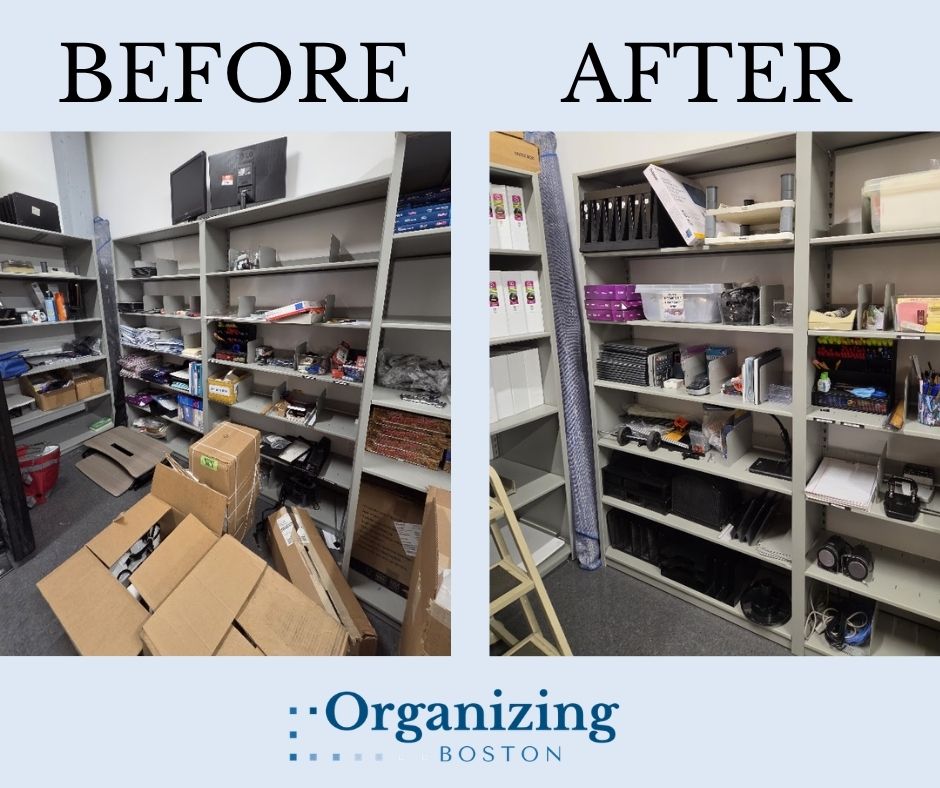
When two businesses merged, Organizing Boston was brought in to remove any signage and merchandise from the old company. The Office Supply Room had become a chaotic collection of various items from both companies. Organizing Boston created zones for testing supplies, mailing supplies and office supplies so that employees could focus on the transition.
Bring Cables and Digital Files Under Control
Tangled cables make even a clean desk look messy. Unplug everything, trace each cord to its device, and use simple ties or clips to keep wires off the floor. Label the ends if you run multiple devices. Store seldom-used chargers out of sight.
Digital clutter counts too. A desktop covered in icons and a download folder full of old files slows you down just like a stuffed cabinet. Delete duplicates, move client work into labeled folders, and set up a backup schedule. A tidy digital workspace supports the physical one.
Close the Day With a Five-Minute Reset
The best organizing system fails when nobody maintains it. Build a short closing routine into each workday. Clear the desk of coffee cups and loose papers. Return pens, notebooks, and cables to their labeled spots. Slide active files and notes into their tray or drawer. Leave the surface ready for tomorrow.
The reset takes minutes but stops clutter from rebuilding night after night. Teams that practice this habit together keep shared printers, supply shelves, and meeting rooms usable for everyone.

When to Call a Boston Office Organizer
A professional organizer is useful when the pile has grown beyond a weekend project. Organizers bring an outside perspective, a clear sequence of steps, and the willingness to make fast decisions about what stays and what goes. Organizing Boston has served the Greater Boston area for over 26 years and works with busy professionals, office managers, and corporations. Our hands-on, judgment-free style keeps the project moving without adding stress.
A local organizer who shows up ready to sort, label, and set up systems will finish the job faster than one who only sends advice by email.
Frequently Asked Questions
Boston business owners ask similar questions when they start looking for office organizing help. Here are the answers.
Expert Support for Every Organizing Need
How much does office decluttering cost in Boston?
Office organizing projects can be arranged hourly or as a package. Either way, the process starts with a complimentary consultation so we can quote you appropriately. Hourly rates suit smaller tasks, while packages offer better value for full-office overhauls.
Do Boston professional organizers work in offices?
Yes. we provide decluttering services and office organizing for small spaces, entire homes, and offices. Organizing Boston serves busy professionals and local businesses through organizing and move management. From stock rooms to storage and desk areas, we are here to support your needs.
How do I keep an office organized after the clutter is gone?
Maintenance is easier than the original cleanout. Keep the daily reset short, store supplies near the point of use, label storage clearly, and limit what can stay on the desk. Review your paper system each month and schedule a deeper tidy-up every season. A few minutes of consistent maintenance will prevent the office from returning to its cluttered state.
What is the best first step for a messy office?
Start with the desk surface and one drawer. Remove everything, sort it into keep, donate, recycle, and shred piles, and put back only what you use daily. Wait before buying new storage containers. If the project feels too large, bring in a professional organizer for a hands-on session and let an outside perspective help you make faster decisions.